


Are you frequently experiencing abdominal issues or unexplained tiredness? Would you desire to eat freely without health worries? You have got our back at Enfield Royal Clinic, as we deliver the premium Food Tolerance Test in Dubai with precise testing, individualised diet plans, and convenient services customised with your preferences and budget constraints.
Essential Highlights
- Expected Cost: Starts from 1450 AED to 2900 AED.
- Procedure Type: A riskless, non-invasive diagnostic evaluation administered by the qualified dietitians or lab practitioners.
- Required Time: 30-60 minutes to gather samples and test completion.
- Outcomes: Usually, 5-7 days are allocated for a thorough food intolerance report.
- Invisible Triggers: Detects food that triggers bloating, skin reactions, or intense fatigue.
- Individualised Nutrition Plan: Assists in formulating a personalised meal plan for better digestion and improved vitality.
What is Food Intolerance?
“Food Intolerance” or “Food Sensitivity” is a condition that is usually experienced when an individual’s body is unable to digest specific food items, leading to certain inconveniences ( diarrhoea, abdominal ache, gas, etc.). While other allergies entail the immune system disturbances, food intolerance greatly impacts the digestive mechanism. In addition, it gradually emerges and has the tendency to worsen if not timely managed on a priority basis. This test delivers essential insights into food sensitivities’ triggers and assists in adjusting the diet to ensure better digestive health.
Common Causes of Food Sensitivity
- It is frequently associated with low levels of enzymes essential for digestion.
- Eggs, corn, wheat, and milk have appeared to be the ultimate triggers.
- Inflammatory Bowel Disease, Celiac Disease, or IBS– specific health ailments- can heighten the sensitivity to unexpected levels.
- Gut flora modifications can negatively alter the individual’s tolerance to certain foods.
- Consistent consumption of a particular food can gradually provoke intestinal irritation over time.
- Standard schedule interruptions or disrupted dietary behaviours might contribute to gut intolerance.
Food Sensitivity Indicators
- Abdominal ache.
- Soft stools or diarrhoea.
- Upset stomach/ acid reflux.
- Frequent migraines or headaches.
- Bloating or gas.
- Feeling nauseous or bloated.
- Repeated burps.
Comprehensive Food Sensitivity Panel
Our food sensitivity test examines diverse items to detect potential intolerance triggers. Via pinpoint recognition, it enables the design of a nutrition strategy that strengthens gut health and reinforces resilience. Therefore, contributing towards optimal wellness.
Food Intolerance: Common Types
Types | Triggers | Symptoms |
Lactose Intolerance | Lactase deficiency in yoghurt, milk, cheese, and other dairy items. | Abdominal bloating, diarrhoea, burps, loose bowels, and stomach ache. |
Gluten Intolerance | Trouble in gluten digestion (not auto-reactive); present in barley, wheat, and rye, etc. | Stomach upset, tightness and intestinal disturbances. |
Histamine Intolerance | DAO enzyme shortage occurs in chocolate, cheese, red wine, and citrus fruits etc. | Migraine, skin flare-ups, and digestive troubles. |
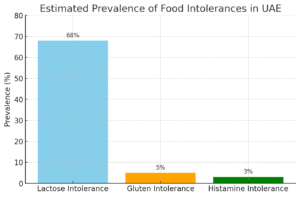
Note: The above graph illustrates the estimated occurrence of usual food intolerances among UAE residents. The most prevalent is lactose intolerance, followed by gluten and histamine intolerance, which is at the lowest.
Benefits of Food Sensitivity Testing
- Recognises Problematic Foods: It plays a vital role in detecting the food items linked to digestive upset, tiredness, or skin irritations.
- Fosters Physical Vitality: Cutting out reactive foods can help an individual reclaim heightened energy levels and reduced exhaustion.
- Enables Individualised Nutrition Strategy: This testing assists nutritionists to craft a personalised meal approach aligning with your bodily requirements.
- Boosts Holistic Wellbeing: It considerably boosts the emotional balance, sharpens focus, and enhances life quality by handling reactive foods.
- Facilitates Digestive Balance: Effectively lessens abdominal concerns by excluding problematic foods.
- Revives Skin Harmony: It significantly aids in alleviating skin concerns that are triggered by specific dietary choices.
Appropriate Candidates
The individuals who are ideally appropriate, along with those who are extremely restricted in receiving food intolerance testing, are mentioned as follows:
✔️ People who are prone to immediately developing gut-associated troubles.
❌ Those with active illnesses or infections when the test is performed.
✔️ ️ Persons with recurring fatigue, headaches, and migraine episodes.
❌ Expectant mothers without obtaining medical approval.
✔️ Anyone experiencing possible dietary sensitivities that are not inspected via basic allergic screenings.
❌ People who are reluctant to comply with dietary restrictions for precise outcomes.
✔️ People with durable digestive ailments, such as autoimmune gastrointestinal concerns, IBS, and celiac disorder.
❌ Minors who lack paediatrician clearance.
✔️ Anyone encountering abnormal weight fluctuations without knowing the reason.
Guidelines to be Observed Before Testing
Below are the instructions that must be considered by those who desire to test for food sensitivity:
- Stick to your usual eating regimen and refrain from meal omission unless prescribed by your healthcare expert.
- Frequently, 8-12 hours minimum, observe fasting (if necessary).
- Record your meal intake in a food diary along with any associated reaction.
- Sufficient fluid intake and caffeine skipping are paramount before testing.
- Update your nutritionist if you encounter any recent sickness or infections that could adversely affect the testing’s outcomes.
This is what happens during Food Sensitivity Testing
Below is the stepwise breakdown of the procedure:
Introductory Assessment
Do arrange a session with your nutritionist at a trusted clinic, where you aware him/ her of your digestive issues, prior sensitivity (if occurred), and medications that you are currently taking.
Specimen Gathering & Diagnostic Techniques
Influenced by the test type, distinct techniques might be employed, i.e.:
Test Type | Illustration |
Blood Test | A minor blood sample is drawn to inspect immune reactions or antibodies triggered by particular foods. |
Elimination Diet | Certain items are eliminated temporarily and progressively reintroduced with time. |
Skin Prick Test | To detect unpleasant reactions, a mild food extract amount is administered on the targeted region of the skin. |
K-Test & Other Specialised Tests | It involves the application of sophisticated diagnostics to reveal subtle dietary insensitivities that remained undetected by the basic testing approaches. |
Vega Testing | A non-intrusive and gentle biofeedback is utilised to reveal any unseen dietary reactions. |
Finger Prick Method | It entails the gathering of a blood sample via a finger-prick. The reports can be availed via online medium or from the lab premises. |
The pictorial depiction of the tests is illustrated below:


Continuous Monitoring
When it comes to specific testing methods like skin pricking or elimination diet, the dietician is obliged to evaluate responses tracked over a specific timeframe. After that, immediate reactions are instantly tracked, and for extended effects, a 24-48 hour wait is compulsory post-testing.
Findings and Assessment
In this phase, the outcomes achieved are documented to make a comprehensive report, followed by the approval or rejection of certain items to be consumed by your nutritionist.
Guidelines to be Observed Post Testing
Following testing, you must religiously comply with these instructions to avoid unpleasant effects.
- Implement the nutritionist guidelines as instructed based on your testing findings.
- Gradually reintroduce items, but solely on your dietitian’s recommendations.
- Organise review visits to track your progress and obtain individualised assistance.
- Eliminate those food options that previously caused issues in your body.
- Report to your healthcare professional if any unpleasant or abnormal reaction occurs.
How are the Outcomes Assessed?
A specified number and a coloured box are assigned to each food item. The higher the IgG value, the greater the sensitivity to that food. While the colour coding highlights those items that appear difficult to notice otherwise.
Food Intolerance vs Food Allergy: What’s the Difference
Characteristics | Food Intolerance | Food Allergy |
Affected Body Mechanism | Digestive system | Defence/ Immune system |
Symptoms | Slight abdominal disturbances (nausea, mild stomach tightness, gas). | Acute symptoms (itchiness, vomiting, or troubled respiration). |
Severity | Typically low-risk and non-fatal. | It can turn fatal in certain cases. |
Immediate Causes | Difficulty in processing specific food items. | Food is perceived as a threat by the body, thus activating the immune system. |
Inception | Within minutes to a few hours post-eating. | It might be triggered instantly and extend for multiple hours after consuming a meal. |
Portion limit | Tiny amounts usually do not emerge as a reason to trigger. | Even a mild quantity can provoke a reaction. |
Food Intolerance Testing: Cost in Dubai
The approximate cost for food intolerance ranges from 1450 AED and goes beyond 2900 AED, accompanied by the cost-determining factors, such as:
🗸 Food Variety tested.
🗸 Blood Sample Collection Technique (blood test, vega test, skin test).
🗸 Clinical expertise.
🗸 Comprehensive findings.
🗸 Guided Nutrition follow-ups.
Discover Improved Digestion and Wellness: Schedule Your Test Today!
Reserve your Food Intolerance Testing at the Enfield Royal Clinic to reveal those food items that adversely affect your health status. Having skilled staff and advanced testing approaches, we deliver precise insights, customised dietary advice, and expert assistance to empower your vitality. Kickstart your journey towards wellness straight away!
FAQs
At what intervals is it permissible to receive food intolerance testing?
Typically, it is suggested that you majorly alter your dietary habits, followed by the emergence of new symptoms, or for periodic reassessment of dietary reactions.
Can weight or energy levels be balanced with this testing approach?
Yes, by identifying the food items that majorly cause digestive distress, it can effectively optimise the nutrient absorption, elevate the vitality, and thus aid in sustaining a proportionate diet.
Is the test effective enough to detect all sorts of food sensitivities?
Not at all. Despite being extensive, several uncommon or recently introduced items might be excluded.
Does food intolerance testing entail the tendency to tackle certain skin concerns?
Definitely! With efficient detection of reactive foods, it majorly assists in tackling specific skin ailments (eczema, rashes, and other skin irritations).
Are the outcomes reliable if I self-diagnose food intolerance without professional testing?
Self-diagnosis is not advised at all. As its symptoms can greatly overlap with other conditions, making formal testing a compulsion.
What will happen if I take certain supplements post-testing?
Specific medications as well as supplements might be a reason for inducing unusual reactions, so it is crucial to notify your dietitian earlier.
Will the test contribute to emotional balance and mental clarity?
Having reduced dietary triggers can considerably elevate your mood, sharpen your focus, and ease moodiness.
Dr. Sannia Awais
Book an Appointment Request appointment information Dr. Sannia Awais Cosmetic Dermatologist and Hair Specialist Speciality:... Dr Mahmoud Akrama
Book an Appointment Request appointment information Dr Mahmoud Akrama Dermatologist and General Practitioner Speciality: General Practitioner,... Dr. Tamim Hasan
Book an Appointment Request appointment information Dr. Tamim Hasan DHA-LICENSED DENTIST Speciality: Cosmetic Dentistry and... Dr. Leen Makhlof
Book an Appointment Request appointment information Dr. Leen Makhlof Dermatologist and Nutritionist Speciality: Dermatology and nutrition... Dr. Sirouse Ghouchkhani
Book an Appointment Request appointment information Dr. Sirouse Ghouchkhani Lead Plastic & Reconstructive Surgeon Speciality: Plastic... Dr. Hemissi Bilel
Book an Appointment Request appointment information Dr. Hemissi Bilel Lead Aesthetic & General Dentist Speciality:General... Dr. Mohamad Sameer Alsalih
Book an Appointment Request appointment information Dr. Mohamad Sameer Alsalih Dermatologist and Aesthetic Skin Specialist... Dr. Mahya Kanani
Book an Appointment Request appointment information Dr. Mahya Kanani Obstetrician & Gynecologist Speciality: Cosmetic Gynecology... Dr. Kian Goudarzi
Book an Appointment Request appointment information Dr. Kian Goudarzi Lead Dermatologist | General Practitioner Speciality: Aesthetic... Dr. Elissa El Ahmadieh
Book an Appointment Request appointment information Dr. Elissa El Ahmadieh Clinical Dietitian, Head of Diet...