


Struggling with excessive bleeding, cramping, or unease because of uterine fibroids? Timely medical intervention ensures elevated recovery and favorable outcomes. Our professionals at Enfield Royal Clinic provide specialized Myomectomy in Dubai, with premium techniques to discard fibroids while safeguarding the uterus effectively.
Quick Facts!
- Treatment Aim: Secure elimination of fibroids, alleviation of symptoms, minimization of future reappearance, and promotion of overall well-being.
- Estimated Cost: Starts from 45,000 AED
- Utilized Techniques: Options involve hysteroscopic myomectomy, laparoscopic myomectomy, or open surgical treatments, determined by the patient’s condition.
- Per Session Duration: Influenced by the procedural complexity, takes around 60-120 minutes.
- Treatment Security: DHA-licensed professionals conduct procedures by employing premium equipment in compliance with the global healthcare protocols.
What is Myomectomy?
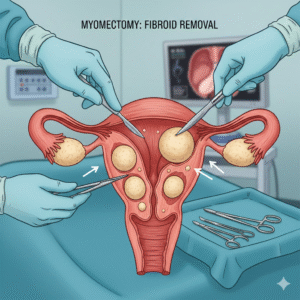
Myomectomy is an operational means of eliminating fibroids from the uterus while ensuring that the uterus remains unaffected. It can be carried out via various techniques and is intended to preserve uterine function and vitality, thus appearing as a preferred selection for those women desiring future pregnancies.
Common Names for Myomectomy
- Uterine fibroid surgery
- Uterine myomectomy
- Myoma resection
- Fibroid removal surgery
- Fibroidectomy
- Leiomyoma resection
What are Fibroids?
These are referred to as non-cancerous, non-threatening tumours that usually appear in the uterus lining, impacting nearly 50% of women, particularly in their later years. They get formulated in various locations, such as embedded within the uterus wall, on either its outer or inner lining, or attached separately. They can be of various forms and dimensions, and frequently affect the indications and therapy choices.
Types of Myomectomy
Names | Procedure Overview | Indications/ Notes |
Open (Abdominal) Myomectomy) | Eliminating fibroids it involves abdominal incisions, whether vertical or horizontal, to reach the uterus. | Appropriate for extensive or multiple fibroids, provides entire pelvic visualization; extended recovery period. |
Robotic Myomectomy | Quite similar to a laparoscopic operation, it entails the utilization of robotic-controlled tools operated by the surgeon from a console. | Delivers amplified precision and command, applicable for laparoscopic-like cases; extended procedure, and is costlier. |
Laparoscopic Myomectomy | In it, minor incisions are carried out in the abdomen via laparoscope, and fibroids are extracted in fragments. | Suitable for tiny or limited fibroids; secure, reduced complications, and prompt recovery. |
Hysteroscopic Myomectomy | It is the fibroids extraction via narrow, light-assisted devices inserted through the vaginal route and cervix. | Majorly employed for submucosal fibroids; least invasive and rapid, though repeat surgery might be required for the extraction of enlarged fibroids. |
Why is it done?
Usually, fibroid surgery is suggested when a woman encounters certain complications and symptoms associated with fibroids that disrupt routine functioning and reproductive capability.
- Persistent and intense menstruation or anemia that appears impossible to tackle with medicational.
- Constant pelvic discomfort or heaviness that continues despite medical assistance.
- Pregnancy-associated complications as fibroids, can elevate the possibility of miscarriage or early delivery (preterm birth).
- Bladder or bowel complications as excessive pressure on adjacent organs by fibroid, can lead to uterine leakage or bowel-movement troubles ( hard stool, constipation).
- Pregnancy issues when conception is adversely impacted by the fibroids.
- For uterus preservation.
Benefits of Myomectomy
These involve:
- Symptoms Ease: This surgery is extremely significant in enhancing the routine ease by effectively alleviating the intense menstruation, pelvic discomfort, or strain on nearby organs.
- Psychological Wellbeing: Uterus retention leads to positive psychological or emotional impacts on those women concerned about their reproductive wellness.
- Reduction of Pregnancy Complications: Fibroid extraction considerably elevates the conception rate by lessening the miscarriage or early labour possibilities.
- Fertility Preservation: This procedure efficiently enhances the uterus’s integrity, thus enhancing women’s potential to conceive later.
- Improved Living Standards: By easing discomfort and functional limitations, women can easily manage their routine with greater ease.
- Non-Hysterectomy Fibroids Options: It manages troublesome fibroids along with uterus preservation, aiding in maintaining the conception ability.
Who is Suitable for a Myomectomy?
The suitability and approach selection are determined by the various factors:
Eligible Candidates ✔️
- Women having fibroids that are operable, determined by the count, symmetry, or position.
- Those females desire to retain their uterus, allowing them to conceive in future times.
- Those who are seeking a substitute for a hysterectomy so that they can preserve their uterus.
- Individuals with clinical conditions or age that enable a secure surgical operation.
Ineligible Candidates ❌
- Women having any sort of cancerous tumour in their uterus region.
- Those experiencing ongoing infections (Hepatitis or HIV).
- Women encountering intense or chronic clinical ailments:
- Asthma.
- Certain cardiac ailments.
- Unusual bleeding patterns.
- Constant kidney damage.
- Compromised blood supply to the legs or arms arose from blocked arteries.
- Diabetes.
Procedural Guide
To clarify the procedural concerns, we have outlined the essential phases below:
a. Pre-Surgery Preparations
- To elevate blood count, it might be suggested to utilize iron supplements or infusions.
- Arrange a discussion appointment with your surgeon to explore management options, fibroid specifics, and associated health considerations.
- The medications, supplements, or vitamins you have been consuming, let your healthcare professional or their staff be aware of them.
- Observe healthy routine practices accompanied by a nutritious diet prior to treatment to promote your wellness.
- Arrive with a query list to be inquired from the gynecologist so that your reservations can be tackled at the time, and you can proceed with the treatment with ease.
- Get done with essential preoperative tests, such as imaging, ultrasound, MRI, hysteroscopy, or blood screening tests.
- To lessen the fibroid size, you might be provided with the Leuprolide acetate (Lupron), but it can result in mood alterations or hot flashes.
b. Arrival & Initial Setup
Our staff will set up an IV line in your hand or arm to deliver essential medications, fluids, and anesthesia upon your arrival. Also, monitoring equipment is installed to consistently observe the heart rate, blood pressure, or other vital bodily functions. To ensure precise and convenient access to your uterus, a catheter might be positioned that assists in maintaining an empty stomach.
c. Anesthesia Administration
Prior to surgical commencement, our team will provide the patient with an appropriate anesthesia choice, which usually appears to be general anesthesia, bringing him into a deep unconscious state. For the least invasive treatment options, a mild sedation is utilized to ensure your ease without placing a windpipe.
d. Surgical Removal of Fibroids
It involves the access of the uterus by the surgeon and the elimination of fibroids entirely or in sections when required. Post their extraction, the uterine wall is thoughtfully reconstructed to regain normal structure. The incisions are enclosed with sutures and wrapped with sterile pads. The utilized time is dependent on the employed procedural technique.
Post-Care Instructions
These involve:
- Verify that the surgical wounds are thoroughly cleaned or dried.
- To minimize strain, limit yourself to non-strenuous workouts, activities, and non-exhausting domestic chores.
- Observe light-paced walking to prevent blood clot formation or for optimal circulation.
- Watch for concerning indications, like intense blood loss, unease, or unusual discharge, and notify your healthcare provider instantly.
- Have the stitches or staples taken out post 05-06 days following surgery.
- Quit intimate activities for 06 weeks at least.
- Consume a fibre-rich, adequately hydrated diet to minimize bowel movements and amplify healing processes.
Recovery Timeline
Myomectomy Techniques | Hospital stay | Recovery |
Hysteroscopic | Outpatient | Minimal tenderness, activity limitations, instant resumption of routine activities. |
Open Abdominal (Laparotomy) | 01-04 days | 04-06 weeks might be required for recovery, intense pain, severe movement limitations, and re-engaging in the usual routine gradually. |
Laparoscopic | Same day or 1 day only | 02-04 weeks for recovery, intermediate/normal ache that can be addressed with medications. |
Outcomes
Post-myomectomy, you might have:
- Enhanced Pregnancy Chances: This surgery is extremely beneficial for those females who have been tirelessly trying to conceive a baby. Usually, it is suggested by the doctors to observe a waiting interval of approximately 03-06 months before attempting pregnancy. It is intended to let the uterus recover fully.
- Improvement in Symptoms: Post-surgery, several women generally tend to feel relief with lighter periods with a noticeable improvement in abdominal strain or pain.
Alternate Options to Myomectomy
Uterine Artery Embolization (UAE)
Being the least invasive procedure, it represents the hindrance of the blood supply to fibroids by the tiny particles, leading to their shrinkage and relieving troublesome effects.
MRI-Guided Focused Ultrasound (MRgFUS)
It appears to be an operationless approach where high-strength ultrasound waves controlled by MRI sufficiently heat fibroids, making them shrink gradually over several months. It is feasible or appropriate for a few patients.
Watchful Waiting
It is feasible in the case of minor or symptomless fibroids, with changes monitored over time.
Hysterectomy
An extremely effective option, indicating the entire extraction of the uterus, which eliminates fibroids, but the negative aspect of it is that it affects women’s fertility, disrupting their capability to conceive in the future.
Radiofrequency Ablation (RFA)
It is the utilization of heat controlled by the targeted ultrasound examination to discard fibroid tissues.
Medications
Certain medications, such as GnRH agonists (to regulate reproductive hormones), might induce a brief shrinkage of fibroids and ease symptoms. There exists a possibility of undesired or adverse effects with inconsistent outcomes.
Myomectomy vs Hysterectomy
| Features | Myomectomy | Hysterectomy |
| Definition | It indicates the operational excision of fibroids with uterus retention. | In it, the entire uterus is extracted via surgical means. |
| Fertility | Maintains reproductive capacity for future conception. | Fertility loss, making pregnancy unachievable. |
| Recovery Period | Typically, 2-6 weeks, determined by the procedural approach. | Usually, the recovery interval is around 04-08 weeks because of extensive surgery. |
| Appropriateness | Females desiring to retain reproductive potential. | Women who encounter intense uterine illnesses or who are uninterested in conceiving children in the future. |
| Purpose | Fibroids treatment with fertility remains unaffected. | Fibroid management along with other uterine ailments or cancer. |
| Invasiveness | Least invasive, influenced by the chosen approach. | Majorly invasive by involving the uterus elimination always. |
| Fibroids Recurrence | Might redevelop, requiring additional treatment. | Never, as the uterus is already removed. |
Myomectomy Risks
- Significant blood loss throughout the procedure, often entailing the requirement of a blood transfusion.
- Adhesions (scar tissue) might develop in the uterus or pelvic region.
- Enhanced probability of fibroids regrowth, highlighting further treatment requirements.
- Formation of blood clots or potential damage to the adjacent organs.
- Elevated possibility of C-section in subsequent pregnancies.
- Infections likelihood at the treatment site.
- Anesthesia-linked allergic responses.
Ways to Minimize Risks
- Improve Blood Parameters: To lessen the procedural bleeding, one must intake vitamin supplements or iron if anemic.
- Select the least Invasive Techniques: To minimize scar development and prompt recovery, opt for options like laparoscopic or hysteroscopic myomectomy.
- Post-Procedural Evaluations: To spot out the complications in their initial stages and to prevent fibroid reestablishment, review appointments must be complied with.
- Precise Surgical Technique: Uterine rupture is effectively handled with cautious handling and accurate repair of the uterine wall.
Why Choose Enfield Royal Clinic
Below is why we stand out as a leading choice for our clients:
- Expert gynecologists with recognized expertise in myomectomy procedures.
- Premium operational technology for accurate, least invasive treatments.
- Comprehensive assistance spanning from initial evaluation to post-operative guidelines.
- Exceptional commitment to security, hygiene, and patient wellness.
- Individualized treatment strategies are guided by each patient’s conditions.
Myomectomy Cost in Dubai
The usual pricing for Myomectomy in Dubai starts from AED 45,000, though the exact cost bracket is determined in the initial appointment in accordance with the factors, such as:
- Myomectomy technique (open abdominal, hysteroscopic, laparoscopic).
- Professional expertise.
- Count and dimensions of fibroids.
- Complementary treatments (if required).
Restore Uterine Health with Myomectomy in Dubai
Don’t allow fibroids to hold you back from living fully. Our certified surgeons, with superior yet minor-incision techniques, ensure the effective elimination of fibroids without adversely impacting your uterus at Enfield Royal Clinic. Achieve individualized assistance, prompt recovery, and renewed ease. Secure your visit today and embark on your wellness path!
FAQs
Will this surgery induce any sort of physiological changes in my body?
Not at all, as the uterus remains functional and fibroid-related indications get significantly improved.
What exactly is a power morcellator, and is it safe to be utilized?
It’s a device that operates by eliminating fibroids via tiny incisions. Though it’s generally secure, yet entails a possibility of leftover tissues or organ trauma.
How would I find out if laparoscopic myomectomy is appropriate in my case?
If your fibroid count is above 5 at a minimum, each having a dimension of >8cm, then you might be suggested for laparoscopic myomectomy.
Post-myomectomy, will I require a C-section?
Whether a C-section is required will be determined by the incision’s position and size.
Does myomectomy also involve ovaries excision?
No, it is ensured that the ovaries must be retained in each employed technique.
What appears to be the approximate recovery period for myomectomy?
Mainly, it is influenced by the employed technique, as the open abdominal technique requires around 4-6 weeks, while 2-3 weeks must be observed as a resting period post-laparoscopic myomectomy.
Dr. Sannia Awais
Book an Appointment Request appointment information Dr. Sannia Awais Cosmetic Dermatologist and Hair Specialist Speciality:... Dr Mahmoud Akrama
Book an Appointment Request appointment information Dr Mahmoud Akrama Dermatologist and General Practitioner Speciality: General Practitioner,... Dr. Tamim Hasan
Book an Appointment Request appointment information Dr. Tamim Hasan DHA-LICENSED DENTIST Speciality: Cosmetic Dentistry and... Dr. Leen Makhlof
Book an Appointment Request appointment information Dr. Leen Makhlof Dermatologist and Nutritionist Speciality: Dermatology and nutrition... Dr. Sirouse Ghouchkhani
Book an Appointment Request appointment information Dr. Sirouse Ghouchkhani Lead Plastic & Reconstructive Surgeon Speciality: Plastic... Dr. Hemissi Bilel
Book an Appointment Request appointment information Dr. Hemissi Bilel Lead Aesthetic & General Dentist Speciality:General... Dr. Mohamad Sameer Alsalih
Book an Appointment Request appointment information Dr. Mohamad Sameer Alsalih Dermatologist and Aesthetic Skin Specialist... Dr. Mahya Kanani
Book an Appointment Request appointment information Dr. Mahya Kanani Obstetrician & Gynecologist Speciality: Cosmetic Gynecology... Dr. Kian Goudarzi
Book an Appointment Request appointment information Dr. Kian Goudarzi Lead Dermatologist | General Practitioner Speciality: Aesthetic... Dr. Elissa El Ahmadieh
Book an Appointment Request appointment information Dr. Elissa El Ahmadieh Clinical Dietitian, Head of Diet... Dr. Atena Shafaei
Book an Appointment Request appointment information Dr. Atena Shafaei Consultant Obstetrician & Gynecologist Speciality: Obstetrics &... Dr Hamza Saleem
Book an Appointment Request appointment information Dr. Hamza Saleem Hair Transplant Specialist Speciality: Hair Transplantation Nationality: Pakistan...